 ProductReveal
About this product
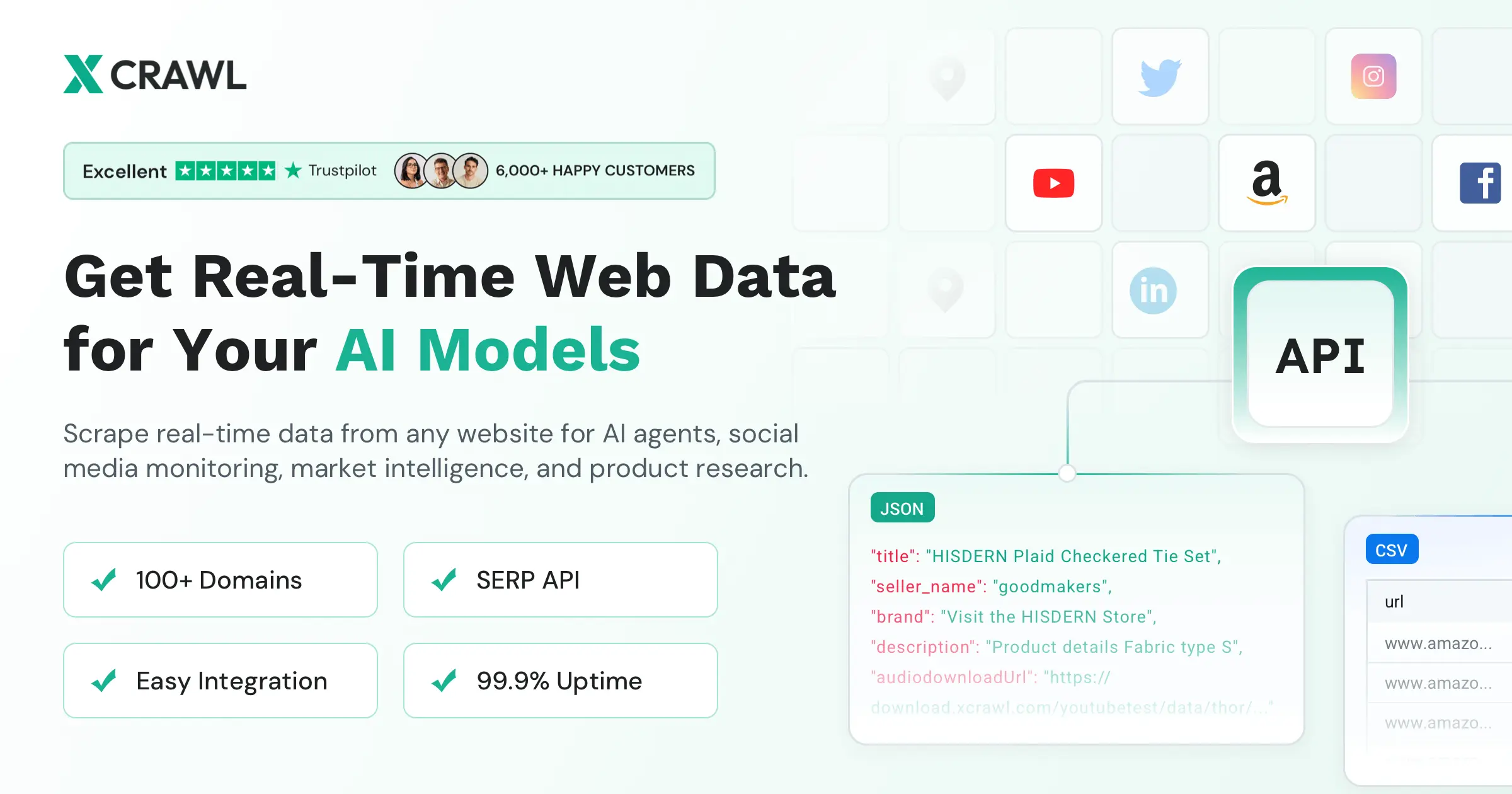
XCrawl is a web data API for people who need live pages inside an AI product, not another dashboard to babysit. You send a request and get back text or structured data you can drop into a model, a search index, or an automation. The service is built by Xcrawl LLC and the public site is https://www.xcrawl.ai/.
What problem it is trying to solve
Teams that feed the web into large language models usually end up owning a pile of side systems. Someone has to run a browser, rotate proxies, retry failed fetches, and then clean the HTML into something a model can read. XCrawl's pitch is that those chores stay on its side of the API. You describe the page or the job, and the response is Markdown, JSON, HTML, a link list, or a screenshot.
That is a narrower job than a general AI tool. It does not write your marketing copy and it does not chat. It fetches public web content and shapes it. For a developer that is the useful part, because the model stays in the stack you already run.
The four jobs the API actually covers
The scrape endpoint is the everyday call. Point it at one public URL and ask for clean Markdown, structured JSON (including extraction against a schema you supply), raw HTML, a list of links, or a screenshot. Sync mode is there when you want the answer in the same request. Async mode is there when the page is slow or you would rather pick the result up later.
The crawl endpoint is for a whole site or a section of one. You set scope and depth, then collect the result when the job finishes or through a webhook. That is the difference between reading one page and reading a documentation set or a blog.
The map endpoint does less and that is the point. It lists the URLs a domain exposes, which is handy before you spend credits crawling, and handy when you only need a picture of site structure.
The search endpoint returns structured results from Google, Bing, DuckDuckGo, Yahoo, Baidu, Naver and others, with location and language options. Google coverage includes web, news, images, shopping and maps. There are also ready-made data endpoints for sources such as Amazon, Walmart, eBay, YouTube, Reddit and app stores. JavaScript-heavy pages are rendered before extraction. Each response reports how many credits it used, so you can see cost per call instead of guessing.
Who it fits
The natural users are developers wiring retrieval-augmented generation, agents that have to open a page, and automations that watch a site. Typical jobs include knowledge bases, agent browsing, SEO rank checks, price and competitor monitoring, review analysis and lead research. If you already live in Python or Node, there are official SDKs (pip install xcrawl, and the Node package @xcrawl/xcrawl), plus a CLI. If you live in an agent client, there is an MCP server aimed at Claude Code, Codex and other MCP clients. If you live in n8n, there is a community node. A Dify plugin and open agent skills sit on the GitHub organization at https://github.com/xcrawl-api. Docs are at https://docs.xcrawl.com/.
It is a weaker fit if you wanted a no-setup consumer app, a hosted chatbot, or a fully open-source crawler you run on your own machines. The SDKs, CLI, n8n node, Dify plugin and skills are open. The fetching service itself is hosted SaaS.
Pricing, in plain terms
New accounts start with 1,000 free credits and the signup does not ask for a card. After that, paid monthly or yearly credit plans exist. The honest way to read freemium here is: you can try a real workload for free, then you pay for volume. Credits are the meter, and the API tells you what a call consumed.
What a careful reviewer should still check
A few limits are worth stating so this does not read like an ad. XCrawl is not a promise that every page on the internet will come back perfectly. Rendering and retries are handled for you, but messy sites, logins and paywalled content are outside a simple public-URL fetch. You should test the pages you actually care about during the free credits, not after you have built the pipeline. The product is also young in public: the GitHub organization and the X account at https://x.com/XCrawl_API date from December 2025, so you will not find a long independent review history yet.
Compared with running your own headless browsers, the trade is control for time. You give up owning the proxy pool and you gain a single API with scrape, crawl, map and search in one place. Compared with other web-data APIs, the angle XCrawl leans on is the AI-shaped output: Markdown and JSON that are meant to land in a model, plus MCP and n8n so the same API shows up where agents and automations already run.
If that is the hole in your stack, the free credits are enough to find out. If you needed a finished SEO suite, a rank-tracking dashboard, or a writer, this is the wrong listing and you should look elsewhere.
Key features
- Scrape a public URL into Markdown, JSON, HTML or a screenshot
- Crawl a site with scope and depth rules, then fetch results or use a webhook
- Map the URLs a domain exposes before you spend crawl credits
- Structured search results from Google, Bing, DuckDuckGo and other engines
- Python and Node SDKs, a CLI, an MCP server and an n8n node
Pros
- One API for scrape, crawl, map and search
- 1,000 free credits and no card
- Markdown and JSON shaped for RAG and agents
Cons
- Hosted SaaS, not a crawler you run yourself
- Young public project with a short review history
- Heavy crawls spend credits after the free tier
Reviews
Reviews are moderated before appearing publicly.
No reviews yet — be the first to share your experience.