 ProductReveal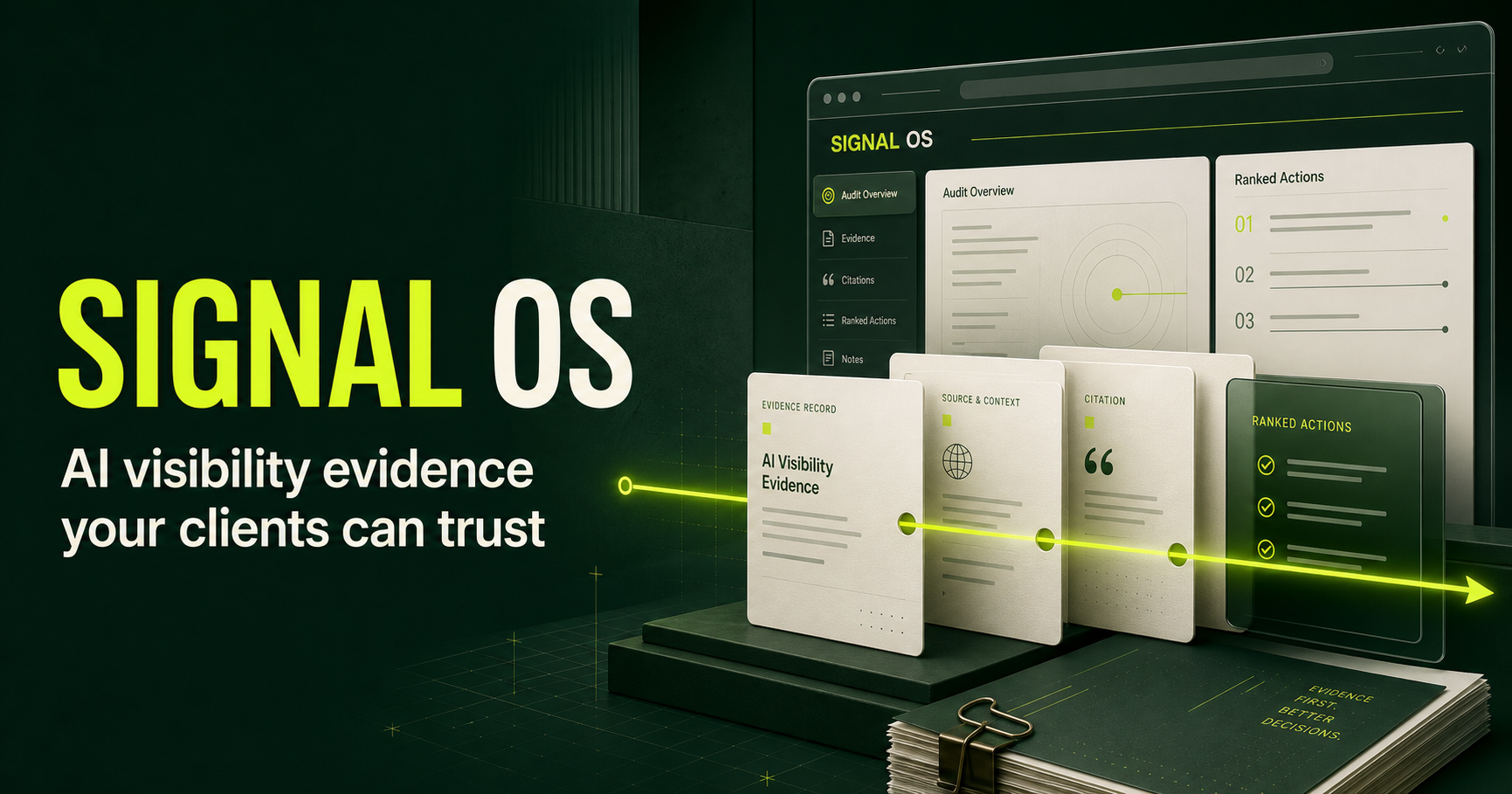
About this product
Vendor-supplied product overview
This listing text is supplied by the maker and should not be read as an independent customer review or a customer case study.
Signal OS is an evidence-first, browser-local AI visibility audit workstation built by Forhemit PBC. It is designed for SEO consultants, marketing freelancers, and small agencies that want to offer structured AEO and GEO audits without first committing to another recurring monitoring platform. The product turns human-run tests of AI answer systems into dated evidence, directional metrics, a prioritized action backlog, and client-ready deliverables.
The core problem is not a shortage of dashboards. It is the difficulty of showing clients exactly what was tested, when it was tested, what an AI system returned, and how a recommendation follows from that evidence. Signal OS keeps the prompt, prompt source, engine, model or version when known, location or account context, timestamp, repetition number, exact answer observations, citations, competitors, factual accuracy notes, and reviewer notes together. Results remain separated by engine and topic so a strong result in one environment does not hide a weak result in another.
The workflow is intentionally manual and transparent. Signal OS does not scrape or automatically query ChatGPT, Gemini, Perplexity, or other AI platforms. A user runs relevant prompts in the target systems and records the observations. The workstation then calculates directional mention rate, citation rate, competitor share, consistency, and factual accuracy from the recorded sample. It also shows sample coverage and confidence bands and avoids issuing a definitive grade below the documented minimum.
Audit setup captures the brand, domain, country, audience, offer, competitors, and audit date. Prompts can be grouped by buyer intent and topic. Each prompt requires a source, such as Search Console language, sales or support language, an interview, People Also Ask, a paid-search term, another observed source, or a clearly labeled hypothesis. That provenance helps a consultant explain why each test belongs in the audit.
The action-priority workflow scores gaps using evidence, commercial intent, impact, and effort. The generated report includes the audit date, methodology, sample size, results, limitations, priorities, and a 30-day plan. Users can export audit data to CSV or JSON and produce reports through print-to-PDF. The working data stays in the browser on the device used for the audit, and the product does not require a cloud account, external API key, or monthly subscription.
There are three one-time license editions. Solo is for one buyer-owned business and includes the offline workstation, methodology playbook, prompt provenance worksheet, result logger, baseline snapshot, action-priority workflow, and internal-use report. Agency adds a one-user commercial license for unlimited client audits, white-label reporting and presentation mode, a proposal and statement-of-work generator, pricing calculator, onboarding questionnaire, sales-call outline, objection guide, 30-day roadmap, and monthly re-audit template. Studio adds internal use for up to ten team members, a training deck, analyst procedure, quality-assurance checklist, manager review workflow, role-based handoff template, and an internal training exercise.
The founding prices shown at launch are USD 99 for Solo, USD 349 for Agency, and USD 749 for Studio. These are one-time prices rather than subscriptions. Buyers should check the official page for the current price and exact edition terms because the launch pricing changes after the stated founding window.
Signal OS deliberately does not promise citations, rankings, traffic, leads, revenue, or legal compliance. It does not treat schema, an llms.txt file, or a readiness checklist as proof that a brand is visible in AI answers. The methodology recommends freezing a baseline prompt set, repeating high-value prompts, treating changes smaller than the observed noise band as inconclusive, and completing a human-review checklist before client delivery.
Public technical diligence on August 2, 2026 records 26 product tests and 84 storefront tests. Release packages include manifests and SHA-256 checksums so buyers can verify files after delivery. No formal security certification is claimed. The public sample report is clearly labeled fictional and illustrative rather than presented as a customer result.
Signal OS is a fit for consultants and agencies that value repeatable methodology, editable client assets, local working data, and honest limitations. It is not a fit for teams that primarily need automated daily monitoring, a hosted client portal, keyword volume data, backlink data, crawling, or traffic attribution. The official page includes a free 15-minute scorecard, an evidence-log template, a fictional sample report, a pricing calculator, an agency proposal template, and detailed edition contents for evaluation before purchase.
Key features
- Browser-local audit workspace with backup and restore
- Prompt provenance and dated evidence records
- Engine-separated metrics and confidence bands
- Ranked actions and client-ready reports
- Three one-time license editions for solo and team use
Pros
- One-time pricing
- Browser-local working data
- Transparent evidence workflow
- White-label client assets in Agency and Studio
Cons
- No automated AI-platform querying
- No hosted client portal
- Requires manual evidence collection and human review
Reviews
Reviews are moderated before appearing publicly.
No reviews yet — be the first to share your experience.