 ProductReveal
About this product
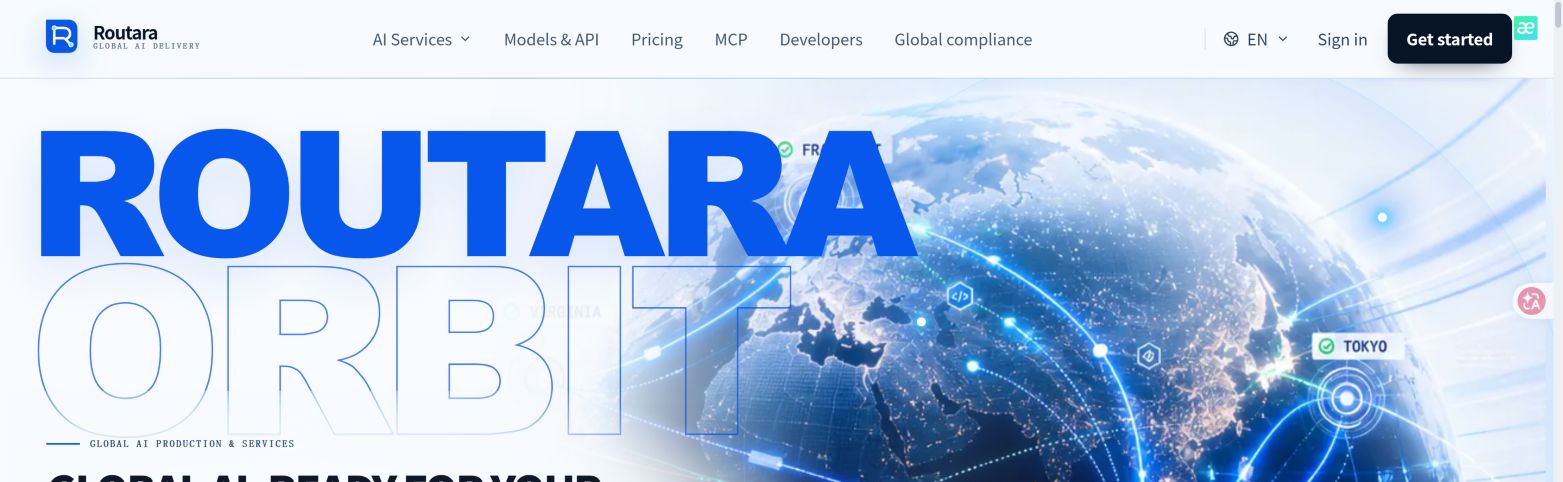
Routara is an OpenAI-compatible AI gateway designed for developers who need to work with several model providers without rebuilding the same integration for every vendor. The product keeps the client-side contract familiar while placing model discovery, routing health, usage tracking, tools, and MCP access behind one consistent surface. This makes it useful for teams that are still comparing providers as well as teams that already know they need fallback routes and operational visibility.
The main problem Routara addresses is fragmentation. Model providers differ in identifiers, client libraries, request formats, pricing rules, availability, and regional behavior. A prototype can tolerate several one-off integrations, but that approach becomes difficult to maintain when a product grows. Routara uses an OpenAI-compatible interface so existing SDK patterns can be reused, while its live catalog exposes more than 767 model entries. The number is presented as a live catalog figure rather than a permanent promise because upstream availability changes over time.
Model discovery is one of the strongest practical features. Developers can inspect the current catalog instead of maintaining a hard-coded list in an application. Route-health checks add another operational layer: a model name alone does not show whether a route is currently usable, so continuous probing helps teams distinguish a configuration problem from an upstream issue. The website also presents usage-based billing information and account controls in the same product rather than leaving every provider integration to implement its own tracking flow.
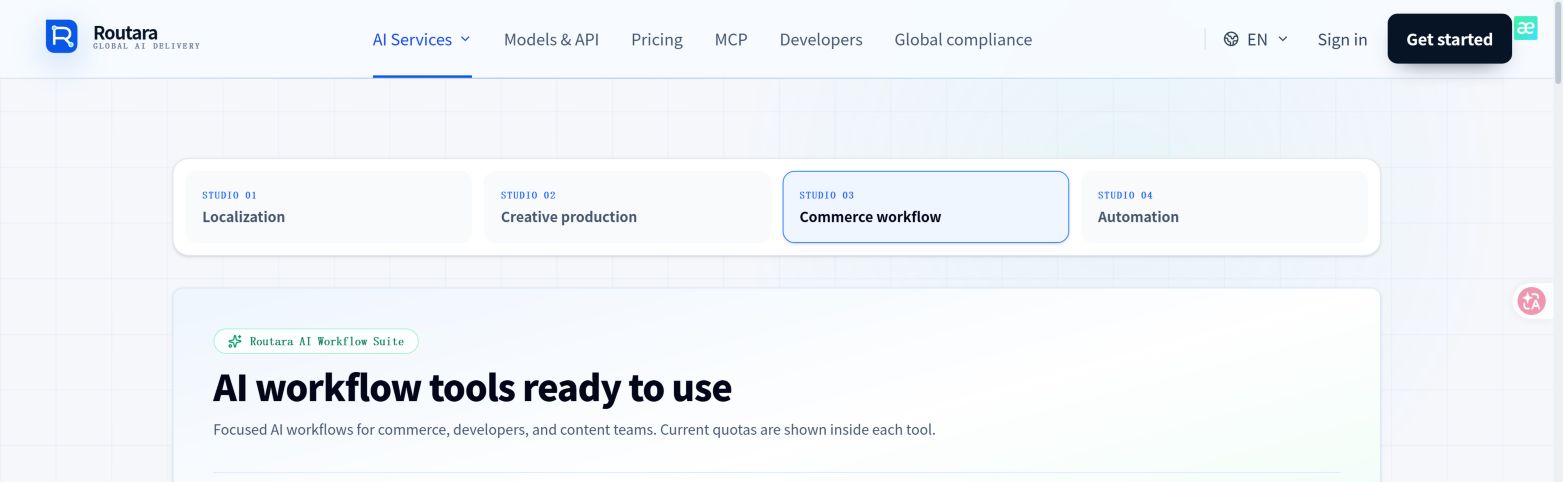
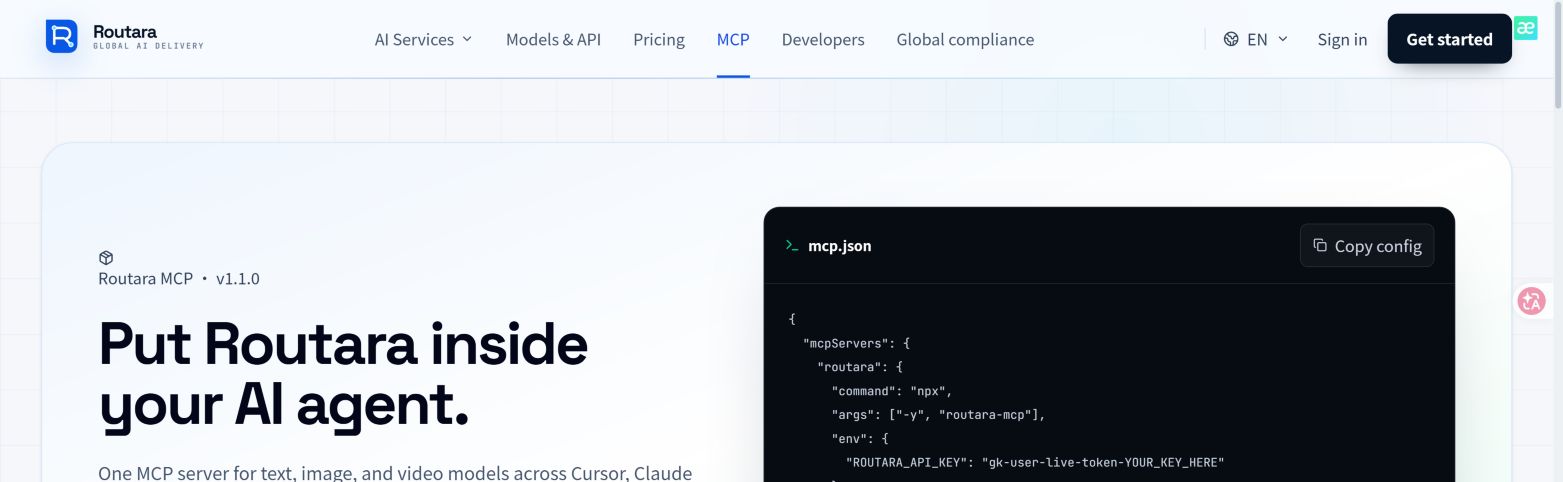
Routara is not limited to a chat endpoint. The site includes structured web tools for common AI workflows and an MCP integration intended for developer clients such as Cursor, Claude Desktop, Codex, Windsurf, and VS Code. The open-source Routara MCP server exposes tools for listing models, chat, image generation, video generation, and video-status checks. This is useful when a developer wants the same gateway to be callable from an agent or coding environment without creating a separate adapter for each client.
The interface supports ten languages, which makes the documentation and account experience more approachable for international teams. The product pages are organized around models, tools, pricing, documentation, MCP setup, and compliance information. That separation matters because a gateway is not only an API specification; users also need to understand authentication, supported capabilities, account limits, and what happens when an upstream route becomes unavailable.
A typical evaluation path is straightforward. A developer can create an account, obtain an API key, test the OpenAI-compatible endpoint with an existing SDK, inspect the model catalog, and then add the MCP server if agent-based tooling is part of the workflow. Teams can begin with a small integration and change model choices without adding a new SDK branch for every provider. Routara also provides web-based tools so non-developer teammates can evaluate useful workflows before the engineering team commits to deeper API integration.
The product is best suited to developers, AI application teams, agencies, and internal platform groups that value interoperability more than dependence on a single provider. It may be less relevant to a team that uses only one model and never expects to switch, but it becomes more useful as the number of providers, clients, and fallback requirements grows.
Routara is actively maintained, so catalog size, availability, and pricing should be verified on the live site before production use. The clearest advantage is the combination of a familiar API contract, a changing multi-provider catalog, health visibility, structured tools, and an MCP layer in one place. Instead of presenting another isolated model wrapper, Routara focuses on the operational work needed to keep multi-provider AI access usable after the first successful request.
Key features
- OpenAI-compatible API
- Live 767+ model catalog
- Continuous route-health checks
- Structured web tools and usage billing
- Open-source MCP server with five tools
Pros
- OpenAI-compatible client surface
- Live multi-provider model discovery
- Route-health visibility
- Open-source MCP integration
- Ten-language interface
Cons
- Model availability changes with upstream providers
- Production users should verify live pricing and route health
Gallery
Reviews
Reviews are moderated before appearing publicly.
No reviews yet — be the first to share your experience.