 ProductReveal
About this product
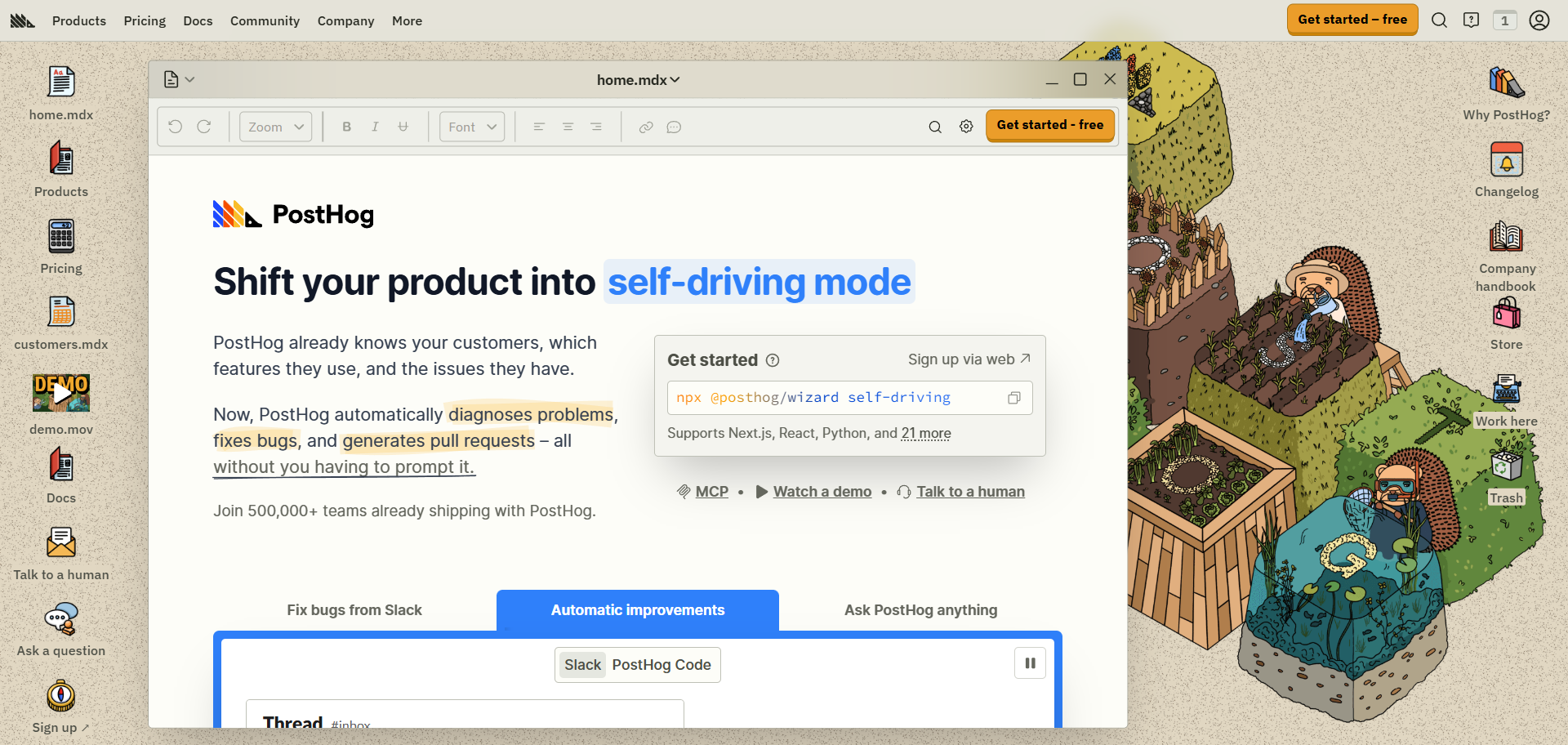
PostHog is a comprehensive product development platform built specifically for developers, product engineers, and modern software teams. Instead of relying on multiple disconnected tools for analytics, feature management, experimentation, debugging, and user feedback, PostHog combines everything into a single unified platform. Its mission is to help teams understand how users interact with their products, identify issues quickly, test new ideas safely, and deliver better software faster.
One of PostHog's biggest strengths is its all-in-one approach. Traditionally, companies needed separate services for product analytics, session recordings, feature flags, A/B testing, error tracking, surveys, data warehousing, and customer data management. PostHog eliminates this complexity by providing all these capabilities within a single ecosystem. This not only reduces software costs but also allows teams to work with a unified dataset, making product decisions more accurate and efficient.
The platform offers powerful product and web analytics that enable businesses to measure user engagement, conversion rates, retention, funnels, feature adoption, and customer journeys. Teams can automatically capture user events or create custom tracking to understand exactly how people use their applications. Advanced visualization tools, SQL querying, trends, lifecycle reports, and user path analysis provide actionable insights for improving products and increasing customer satisfaction.
Another standout feature is Session Replay, which allows developers to watch real user sessions to understand behavior, diagnose bugs, and improve user experience. Combined with heatmaps and error tracking, developers gain complete visibility into customer interactions without relying solely on logs or customer reports. This significantly reduces debugging time and helps engineering teams resolve issues before they affect larger groups of users.
PostHog also includes Feature Flags and Experimentation tools that allow teams to release new features gradually, target specific user groups, conduct A/B tests, and measure the impact of product changes before rolling them out globally. These capabilities help reduce deployment risks while encouraging continuous experimentation and data-driven product development. Developers can confidently test new ideas, validate hypotheses, and improve user engagement based on real-world data rather than assumptions.
As AI-powered applications continue to grow, PostHog has expanded its platform with AI observability and developer-focused AI tools. Teams building LLM-powered applications can monitor prompts, latency, costs, traces, and AI performance from a centralized dashboard. Additionally, PostHog is introducing AI-assisted development capabilities that help engineers automate repetitive tasks, debug applications faster, and accelerate software delivery.
The platform is also highly flexible. Organizations can choose between a fully managed cloud service or self-host the open-source version for greater control over infrastructure and data privacy. Its extensive integration ecosystem supports databases, cloud warehouses, CRMs, payment platforms, and developer tools, making it suitable for startups, SaaS companies, enterprises, and engineering teams of all sizes. Usage-based pricing with generous free monthly limits makes PostHog accessible even for small teams and independent developers.
Overall, PostHog has evolved beyond a traditional analytics platform into a complete product engineering ecosystem. By combining analytics, debugging, experimentation, feature management, customer feedback, AI observability, and data infrastructure in one platform, it enables organizations to build better products while reducing operational complexity. Whether you're launching a startup, scaling a SaaS application, or managing enterprise software, PostHog provides the tools needed to understand users, make informed decisions, and continuously improve product quality.
Key features
- Track user behavior, funnels, conversions, retention, feature adoption, and customer journeys with detailed dashboards and reports.
- Watch real user sessions, analyze heatmaps, and quickly identify usability issues, bugs, and friction points.
- Roll out new features safely, target specific user segments, and measure experiment results before full deployment.
- Monitor application errors, debug issues, and track AI/LLM performance, latency, and costs from one platform.
- Connect hundreds of data sources, centralize customer data, run SQL queries, and automate workflows using built-in integrations.
Pros
- All-in-one platform for analytics, experimentation, debugging, and deployment.
- Open-source with optional self-hosting.
- Generous free tier with usage-based pricing.
- Powerful session replay and heatmap capabilities.
- Built-in feature flags and A/B testing.
- AI observability for modern AI-powered applications.
- Supports 100+ integrations and external data sources.
- Highly scalable for startups and enterprise teams.
- Excellent documentation and active developer community.
- Eliminates the need for multiple standalone developer tools.
Cons
- The wide range of features can be overwhelming for new users.
- Initial implementation requires technical knowledge.
- High-volume usage can become expensive over time.
- Some enterprise and advanced collaboration features require paid plans.
- Non-technical users may face a learning curve when configuring analytics and experiments
Reviews
Reviews are moderated before appearing publicly.
No reviews yet — be the first to share your experience.
Disclaimer: Product information is submitted by makers and reviewed by ProductReveal before publishing. We try to keep details accurate, but pricing, features, and availability may change. Please verify details on the official product website.