 ProductReveal
Bargo
Cross-source market research with an AI analyst and charts shaped around the question.
About this product
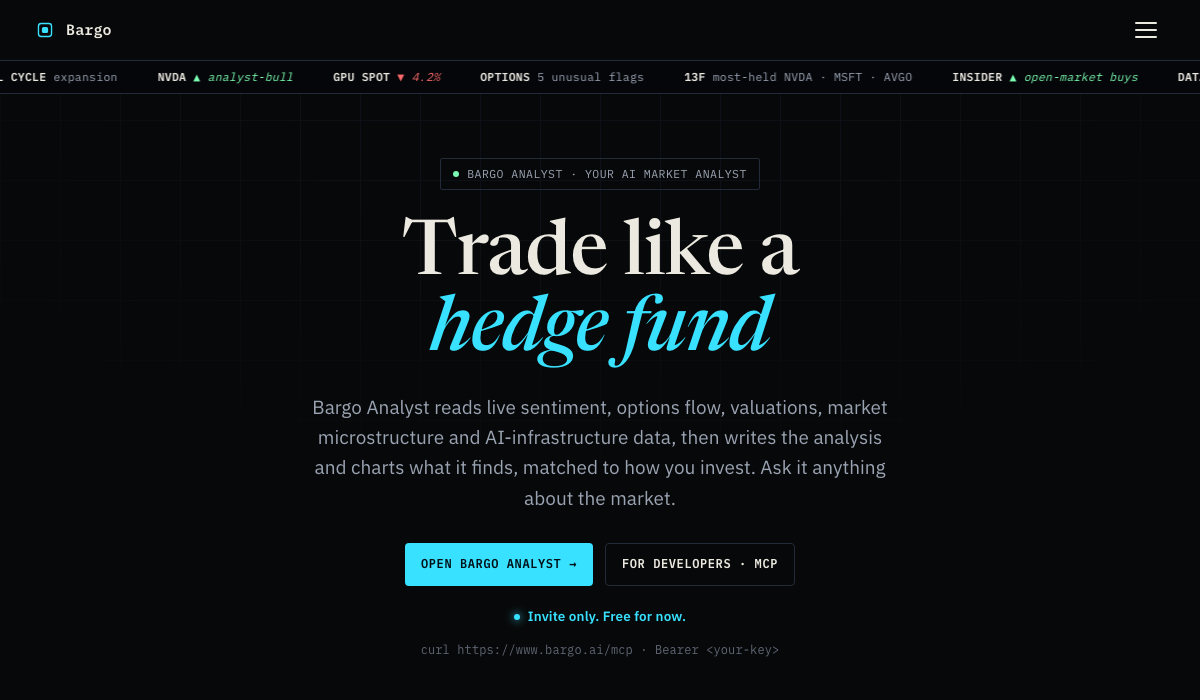
Bargo is most useful when the research question sits between several data sets rather than inside one familiar chart. The product presents itself as an AI market analyst, but the more important idea is the intake behind that analyst: sentiment, options flow, valuation measures, market microstructure, prediction markets, company fundamentals, and data about the infrastructure supporting the AI economy are normalized so they can be considered together. An investor can begin with a company, a sector, or a thesis and ask for an analysis instead of manually moving the same question through a series of terminals and spreadsheets.
The experience is intentionally conversational. Bargo Analyst writes a market read and builds charts that match the prompt, which feels different from opening a dashboard whose panels were chosen before the question existed. This is especially helpful for exploratory work. A user looking at an AI infrastructure name, for example, may need valuation context, options positioning, GPU pricing, demand indicators, and recent sentiment before deciding whether a move reflects company-specific information or a broader capital-cycle signal. Bargo is designed to keep that evidence in one thread and make the reasoning visible enough to challenge.
Breadth is Bargo's clearest strength, though it also defines how the product should be evaluated. No single generated narrative should replace checking the underlying filings, market data, or disclosure documents. The value is in reducing the cost of forming and revising a hypothesis. The analyst can identify relationships worth investigating, organize the supporting material, and create a coherent first pass. Investors still need to decide which assumptions matter and whether the available signals justify a trade. Bargo describes the output as informational rather than financial advice, which is the right boundary for this kind of system.
The product also has an unusually specific view of the AI investment cycle. Alongside conventional market signals, the site publishes measures related to GPU availability and rental pricing, token demand, semiconductor exports, data-center capacity, and credit conditions. That combination can help researchers follow the path from infrastructure spending to utilization and eventually to the companies that capture or lose economic value. It is a more differentiated focus than a generic stock chatbot, and it gives the analyst questions to answer that ordinary quote-and-news products cannot address well.
For developers, Bargo provides a Model Context Protocol connection. Compatible assistants and coding environments can call structured tools rather than rely on scraped search results or copied tables. This makes the same research layer available inside an agent workflow, and it is a practical complement to the web analyst. The integration still requires a free key, so setup is not entirely anonymous, but the documentation explains the remote endpoint and the product is free while in beta.
There are trade-offs. Bargo is invite-only at this stage, so immediate access is not guaranteed. The range of sources also means that freshness, coverage, and methodology can vary by signal. Generated analysis can make a chain of evidence easier to read without eliminating uncertainty in that evidence. Anyone using the output for a consequential decision should open the cited source material, inspect dates and definitions, and treat delayed disclosures—such as congressional or insider filings—with particular care. Users who only need a simple quote screen may find the product broader than necessary.
The strongest fit is an investor, analyst, or technically inclined research team that repeatedly asks cross-source questions. Bargo can save the mechanical work of gathering context and leave more time for testing the conclusion. Its charts and narrative are not the final answer; they are a structured surface for asking the next, better question. That distinction makes the product more credible and more useful than positioning it as an automated trading oracle.
Overall, Bargo is an ambitious early product with a coherent point of view: market intelligence becomes more valuable when agents can traverse live, structured sources and explain how the pieces relate. The invite-only beta and the need to verify important claims are real constraints, but the combination of a conversational analyst, purpose-built visualizations, AI-infrastructure research, and MCP access gives it a distinct role. For users who already spend time reconciling options activity, sentiment, fundamentals, and thematic data, Bargo offers a compelling way to begin that work from one question instead of five separate tools.
Key features
- AI-written market analysis that can compare several structured signals in one research thread
- Question-specific charts spanning sentiment, options, valuations, and market microstructure
- Dedicated indicators for GPU supply, token demand, and the wider AI capital cycle
- Remote MCP connection for bringing live market intelligence into compatible agents
- Invite-only beta access offered free while the product is developed with early users
Pros
- Connects normally separate financial signals inside one research conversation
- Builds charts around the question rather than a fixed dashboard
- Distinct coverage of GPU supply, token demand, and AI infrastructure
- MCP access supports agent and developer workflows
- Free during the invite-only beta
Cons
- Invite-only access may delay onboarding
- Important generated conclusions still require source verification
- Signal freshness and methodology can differ across data sets
Reviews
Reviews are moderated before appearing publicly.
No reviews yet — be the first to share your experience.