 ProductReveal
AgentsKit
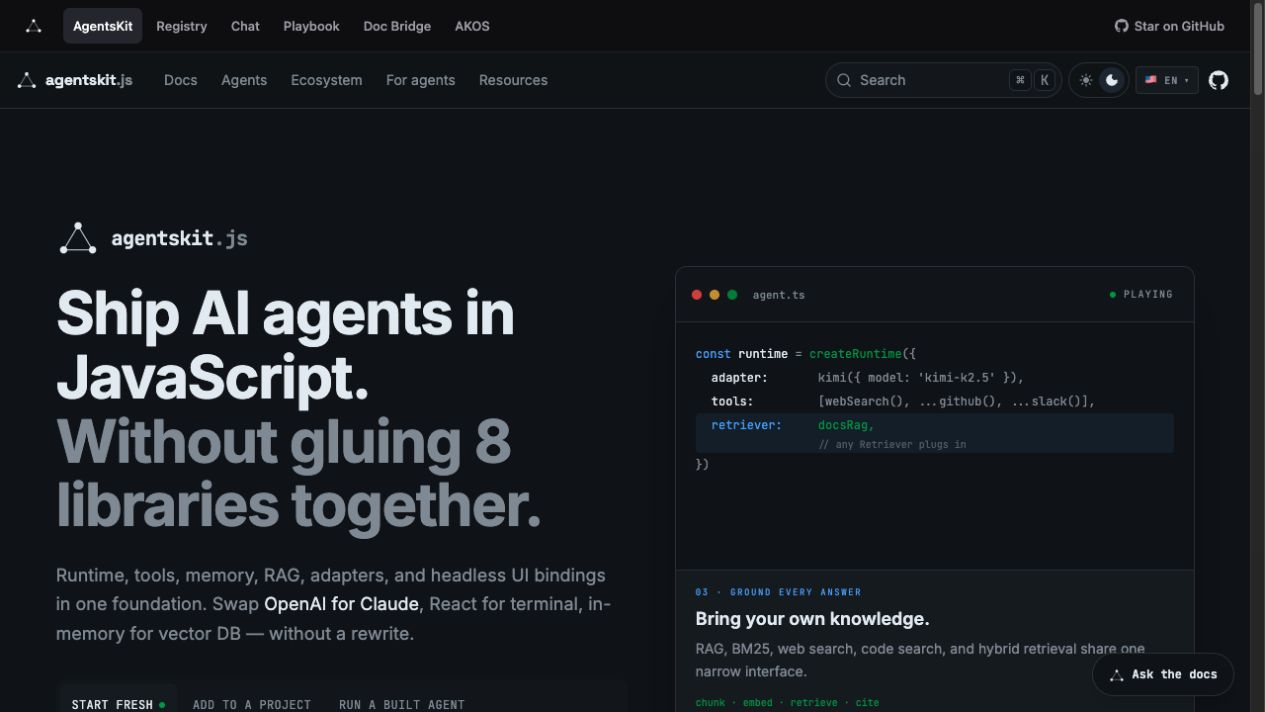
Ship AI agents in JavaScript without locking the stack to one provider.
About this product
### What AgentsKit is
Building an AI agent in JavaScript often starts with a model call and quickly becomes an integration project. The application needs a runtime, tools, memory, retrieval, model adapters, observability, evaluation, sandboxing, and an interface. Developers usually face two uncomfortable choices: adopt a convenient platform that owns most of those decisions, or assemble several unrelated libraries and maintain the boundaries themselves.
AgentsKit is an open-source TypeScript toolkit built for the space between those choices. It provides a common foundation for production agents while keeping the major layers replaceable. The ecosystem is split into independently installable packages rather than one mandatory framework. Teams can start with the small dependency-free core, then add only the runtime, tools, memory, RAG, sandbox, observability, evaluation, React, or terminal packages their application actually needs.
### Why the architecture matters
The practical value is not simply the number of features. It is the boundary between them. AgentsKit defines contracts for adapters, tools, skills, memory, retrieval, and runtimes so that an application does not need to be rewritten when one implementation changes. A team can move between OpenAI, Anthropic, Gemini, Ollama, LangChain, or Vercel AI adapters; replace in-memory storage with a file, SQL, Redis, or vector backend; or move from a browser interface to a terminal workflow while preserving the surrounding application structure.
This approach is useful when a prototype needs to mature without becoming dependent on its first model provider or storage decision. It also helps teams test competing implementations behind the same interface. The contracts make those choices explicit in the code instead of hiding them inside a hosted workflow.
### What is included
The toolkit covers the full path from an initial chat experience to autonomous and evaluated agent workflows. The runtime package supports iterative agent execution. Tools add browser, filesystem, search, code execution, email, and calendar capabilities. Memory and RAG packages provide replaceable persistence and retrieval. Sandboxing supports isolated execution, while observability and evaluation packages make behavior, latency, cost, and quality measurable.
AgentsKit also treats interfaces as replaceable. Its React bindings are headless, so applications keep control of their own design system. The Ink package brings the same agent concepts to terminal interfaces. Templates and the CLI provide shorter paths for trying the toolkit without committing an existing application to the entire stack.
### Who it is for
AgentsKit is most relevant to JavaScript and TypeScript developers who want more structure than a collection of model SDK calls but less lock-in than an all-in-one agent platform. It fits teams building support, research, coding, knowledge, and internal automation agents where provider portability and testable boundaries matter.
The project is MIT-licensed and public on GitHub. The core contract is at version 1.0 and follows a stability promise. Other packages mature independently on 0.x tracks, so teams should check the published stability table before treating every package as frozen. That staged maturity is an honest tradeoff for an ecosystem that is still expanding and testing new integrations.
### Bottom line
AgentsKit does not try to make every infrastructure choice disappear. It makes those choices composable. Developers still decide which model, memory backend, tools, and interface fit the product, but they can make those decisions behind shared TypeScript contracts rather than wiring a new application around each provider. For teams that expect their agent stack to evolve, that replaceability is the main reason to evaluate it.
Key features
- Provider-independent adapters for hosted and local models.
- Independently installable packages on a small dependency-free core.
- Runtime, tools, memory, RAG, sandboxing, observability, and evaluation in one composable ecosystem.
- Headless React and terminal interfaces that preserve control of the product experience.
- Stable TypeScript contracts that allow providers, storage, retrieval, and interfaces to be replaced without rewriting the application.
Pros
- Install only the layers an application needs.
- Replace model providers and backends behind explicit contracts.
- MIT-licensed, TypeScript-first, and publicly developed.
- Covers both user interfaces and production agent infrastructure.
Cons
- Most packages outside the core are still on independent 0.x maturity tracks.
- The ecosystem's breadth means new users should consult the package guide before choosing their initial stack.
Gallery
Reviews
Reviews are moderated before appearing publicly.
No reviews yet — be the first to share your experience.