

It was 3 AM when I realized I’d forgotten to schedule the newsletter. Again.
My coffee had gone cold. The cursor blinked accusingly at me from an empty Google Doc. I had client emails piling up, a podcast transcript that needed summarizing, and a landing page that was supposed to go live yesterday. The worst part? I knew ChatGPT could help with all of it. But I was too exhausted to craft the perfect prompts, manage API keys, or remember which model worked best for which task.
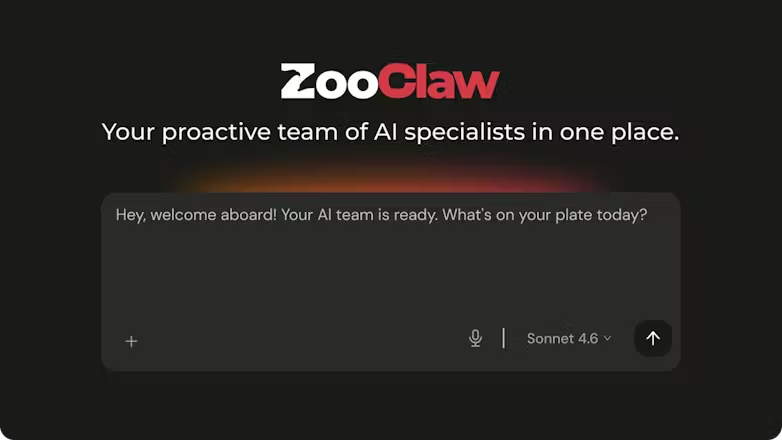
That’s when I stumbled into ZooClaw AI. Not another chatbot begging for prompts, but something claiming to be a proactive team of AI specialists that route your tasks automatically. No setup. No token anxiety. Just… results waiting for you in the morning.
I was skeptical. Everything in AI promises to be “revolutionary” until you realize it requires six hours of configuration and a Discord server full of frustrated developers to get working.
But here’s the thing: ZooClaw is different. And after using it daily for the past two weeks, I’m convinced it represents a genuine shift in how non-technical people will interact with AI. This isn’t just another AI assistant—it’s the first tool I’ve found that actually respects your time more than it demands it.
What Is ZooClaw AI?
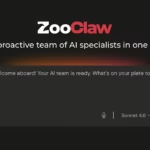
ZooClaw AI is a managed platform that gives you a team of specialized AI agents through one simple interface. Think of it as having Fox (your marketing expert), Owl (your office administrator), and Beaver (your data analyst) on speed dial—except they work while you sleep.
The platform is built on OpenClaw, the open-source AI agent framework that took GitHub by storm with 247,000 stars, but ZooClaw strips away all the technical complexity.
You don’t install anything. You don’t configure API keys. You don’t choose between Claude, GPT-4, or DeepSeek. ZooClaw handles the routing, model selection, and even falls back to open-source models if the primary ones hiccup.
The core problem it solves? The “blank page” paralysis of generic AI. When you open ChatGPT, you’re staring at an empty box that can theoretically do anything—which means you have to decide everything. ZooClaw flips this: you describe what you need in plain English (or voice), and the platform routes your request to the specialist agent designed for that specific job.
Ning Hu, ZooClaw’s founder, stumbled into this insight accidentally. Back in February 2026, he was playing with OpenClaw and built an AI companion agent for fun. When he showed it to his HR lead—someone with zero technical background—she ended up building a career planning agent with 33 iterations in one afternoon. That’s when Hu realized: the barrier isn’t AI capability; it’s giving people the right interface to guide that capability.
Who Is ZooClaw Actually For? (Real Use Cases)
This isn’t a tool for AI researchers or prompt engineering wizards. ZooClaw is explicitly designed for the rest of us—people who need AI to handle real work without becoming a second job themselves.
The Solo Founder Wearing Six Hats You need marketing copy, financial projections, and customer support responses—but you can’t afford six hires. ZooClaw’s specialist routing means your marketing questions go to Fox (who understands brand voice), while your spreadsheet tasks hit Beaver (who handles data analysis). One Reddit user claimed they built a full website in about one minute using ZooClaw, though I’ll take that with a grain of salt.
The HR Professional Who Hates Software Remember Hu’s HR lead? She turned her career coaching expertise into a live agent that now helps ZooClaw users with professional development. If you have domain expertise—whether it’s recruiting, content strategy, or operations—you can potentially package that knowledge into a specialist that works for you 24/7.
The Marketing Manager Drowning in Content One of Hu’s colleagues built a social media agent on the platform that produced a post going viral overnight.
The proactive scheduling means you can set campaigns to run, monitor, and optimize without babysitting the process.
The Consultant Who Wants to Scale ZooClaw is quietly building a “branded agents” feature where experts can white-label their specialists. Imagine sending clients to “YourName Strategy Bot” while ZooClaw handles the infrastructure invisibly. This is still in early access, but it signals where the platform is headed: expertise-as-a-service without the coding overhead.
Key Features That Actually Matter
Intelligent Agent Routing (The “Zoo” System)
Instead of one generalist bot, ZooClaw maintains a collection of specialized agents. When you submit a task—via text or voice—the platform automatically routes it to the appropriate specialist. Marketing tasks go to Fox. Administrative work hits Owl. Data processing goes to Beaver.
Why it matters: You don’t waste time figuring out which AI model is best for coding versus copywriting. The system eliminates decision fatigue by making the routing invisible. According to Hu, they’re building an evaluation framework (ZooEval) to scientifically determine which search skills work best for which tasks, taking the guesswork out of agent selection.
Proactive Execution, Not Reactive Chat
Most AI tools wait for you to ask. ZooClaw’s agents can work on schedules, monitor situations, and follow up automatically. You can literally wake up to completed work.
Why it matters: This shifts AI from a “tool you use” to a “team member who works for you.” The difference is psychological—you stop managing the AI and start delegating to it. For time-zone straddling freelancers or founders in different markets, this 24/7 execution cycle is transformative.
Voice-First Interface
You talk to ZooClaw like you’d talk to a colleague. No prompt engineering. No special syntax. Just natural conversation.
Why it matters: This lowers the barrier to entry dramatically. Hu’s team specifically focused on non-technical users who “never think they can build” AI agents. When building feels like conversation rather than coding, creativity becomes the only limit.
Model Fallback & Zero Token Anxiety
ZooClaw stays synced with the latest models (Claude, GPT-4, etc.) but automatically falls back to top open-source models if needed. You pay a flat monthly rate—no surprise API bills.
Why it matters: OpenClaw users often get burned by unpredictable token costs. ZooClaw’s credit system ($20/month gets you 4,800 credits on the Starter plan) makes budgeting predictable.
When you’re not watching every API call, you actually use the tool instead of hoarding credits.
Built-in Hosting & Deployment
Everything runs on ZooClaw’s infrastructure. No deployment. No server management. No “it works on my machine” debugging.
Why it matters: This is the biggest difference from raw OpenClaw. While OpenClaw requires technical setup and local runtime management, ZooClaw handles the infrastructure entirely.
For business users who need reliability, this managed approach eliminates the security and maintenance headaches of self-hosting.
How ZooClaw Compares to the Alternatives
ZooClaw vs. Raw OpenClaw
If OpenClaw is a powerful engine, ZooClaw is the car you actually drive. OpenClaw targets engineers and “technically-minded folks” who want to tinker. ZooClaw is for “everyday users across a much broader range of real work scenarios.”
Choose OpenClaw if: You want maximum flexibility, don’t mind command-line interfaces, and enjoy configuring skills and integrations yourself.
Choose ZooClaw if: You want AI agents that work immediately without setup, and you value reliability over customization.
ZooClaw vs. ChatGPT/Claude
Generalist AI is great for brainstorming. ZooClaw is built for execution. While ChatGPT can theoretically do anything, it requires you to be the project manager—deciding what to ask, how to ask it, and how to act on the response. ZooClaw’s specialist agents come pre-loaded with domain knowledge and workflows.
Choose ChatGPT if: You want open-ended conversation and exploration.
Choose ZooClaw if: You have specific, repeatable business tasks that need consistent execution without hand-holding.
ZooClaw vs. n8n/Make.com
Traditional automation tools require you to visualize workflows and connect APIs manually. ZooClaw uses natural language and AI agents that understand intent.
Choose n8n if: You have technical resources and need precise, deterministic automation with exact control over each step.
Choose ZooClaw if: You prefer describing outcomes in English and letting AI figure out the implementation.
My Honest Hands-On Experience
I went into this review expecting another overhyped AI wrapper. What I found was surprisingly practical—though not without friction.
The Good: The voice interface actually works. I described a marketing campaign for a hypothetical coffee subscription service, and Fox (the marketing specialist) generated a full 30-day content calendar, email sequences, and social hooks without me touching a keyboard. The proactive scheduling meant I could set it to “monitor competitor pricing weekly” and forget about it.
The specialist routing feels magical when it works. I uploaded a messy CSV of sales data and asked for insights. Instead of getting generic advice, Beaver (the data agent) cleaned the data, identified trends, and suggested visualizations—all without me specifying which tool to use.
The Frustrating: ZooClaw is very new (launched April 2026), and it shows.
The agent handoffs aren’t always seamless. Sometimes Fox and Owl seem to step on each other’s toes if a task spans marketing and operations. The voice recognition occasionally stumbles on technical jargon—though it’s improving rapidly.
The pricing tiers jump significantly. At $20/month for Starter, it’s accessible, but if you need the Pro plan’s 20,000 credits ($83/month), you’re approaching the cost of hiring a part-time virtual assistant from overseas. Whether that’s worth it depends on how much you automate.Table
| Pros | Cons |
|---|---|
| Zero setup required | Still early stage (occasional bugs) |
| Voice-first actually works | Agent handoffs need refinement |
| Predictable pricing (no API surprises) | Credit system can be opaque |
| Proactive task execution | Limited third-party integrations (for now) |
| Built on proven OpenClaw tech | Learning curve for “agent thinking” |
Common Misconceptions (Let’s Bust Some Myths)
Myth 1: “It’s just a wrapper around ChatGPT.” This misses the point entirely. Yes, ZooClaw uses large language models, but the value is in the routing logic, specialist training, and proactive infrastructure. It’s like saying a restaurant is just a wrapper around groceries. The preparation, presentation, and service matter.
Myth 2: “You need to be technical to build custom agents.” Hu’s origin story directly contradicts this. His HR lead built a functional career agent in one afternoon with 33 iterations—without knowing how to code. The platform is explicitly designed so that “building feels like just having a conversation.”
Myth 3: “It’s too expensive compared to using OpenClaw directly.” If you value your time at more than $5/hour, ZooClaw is cheaper. Self-hosting OpenClaw requires server costs, API keys, debugging time, and maintenance. When I tried OpenClaw last month, I spent three hours just getting the environment configured. ZooClaw worked in three minutes. That’s worth $20/month to me.
Pro Tips Most Users Miss
- Start with voice, refine with text. The voice interface is great for dumping your thoughts, but use text for precise edits. The combo is more powerful than either alone.
- Let agents argue. If you’re unsure which specialist to use, describe the task ambiguously and let ZooClaw’s routing figure it out. The evaluation framework often picks better than you would.
- Schedule everything. The real power is in proactive mode. Don’t just ask for a task—ask for it to repeat weekly. “Monitor my competitor’s blog every Monday morning” is infinitely more valuable than a one-time analysis.
- Build in iterations. Like Hu’s HR colleague, don’t try to perfect your agent in one go. Start simple, test it, then refine. The platform tracks versions so you can roll back if an iteration breaks something.
- Watch the ZooEval blog. ZooClaw publishes research on which agent configurations perform best. This is free consulting on how to optimize your automations—most users ignore it.
Pricing Breakdown: Is It Worth It?
Starter Plan ($20/month, billed annually):
- 4,800 credits/month
- 2 CPU cores, 4GB RAM, 40GB storage
- Unlimited free model access
- Image, video, and audio generation
- Full access to all specialist agents
Pro Plan ($83/month):
- 20,000 credits (4x the usage)
- 4 cores, 8GB RAM, 200GB storage
- Advanced generation features
- Multi-channel deployment
Ultra Plan ($167/month):
- 40,000 credits
- 8 cores, 16GB RAM, 1TB storage
- Premium generation models
- Enterprise-grade resources
The Verdict: For individual freelancers and small business owners, the Starter plan is genuinely sufficient. 4,800 credits goes surprisingly far when you’re not burning tokens on failed prompts. The jump to Pro only makes sense if you’re running heavy data processing or managing multiple client accounts.
Compared to hiring a virtual assistant ($400-800/month) or even a tool like n8n Pro ($50/month plus hosting), ZooClaw sits in a sweet spot of capability versus cost.
Final Verdict: Should You Join the Zoo?
Use ZooClaw if:
- You’re a non-technical professional who needs AI automation without the setup headache
- You handle repetitive marketing, administrative, or data tasks weekly
- You value proactive execution over reactive chatting
- You want predictable costs instead of surprise API bills
- You’re intrigued by AI agents but intimidated by OpenClaw’s technical requirements
Skip it if:
- You’re a developer who enjoys configuring OpenClaw manually
- You need highly customized, niche automations that don’t fit standard workflows
- You require enterprise-grade security certifications (though they’re working on this)
- You’re looking for a simple chatbot replacement (this is overkill for basic Q&A)
ZooClaw isn’t perfect. It’s early software with occasional rough edges. But it represents something important: the democratization of AI agents. For the first time, someone with zero coding skills can deploy a team of specialized AI workers that actually get things done while they sleep.
The “one-person company” era is here, as Hu puts it.
But even solo operators deserve a team. ZooClaw is the first tool I’ve found that actually delivers on that promise without requiring a computer science degree to operate.
My recommendation? Try the 7-day free trial. Build one agent. Set one scheduled task. See if your morning inbox looks different. For $20/month, that’s a bet worth taking.
ZooClaw Official Site – zooclaw.ai