

Introduction
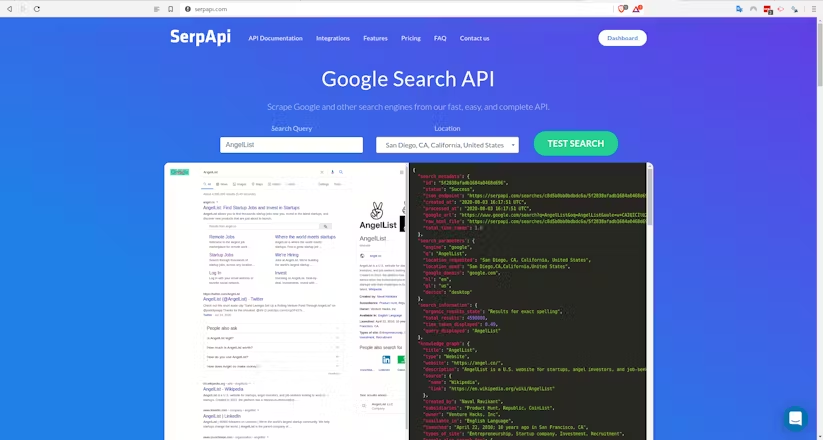
SerpApi is a developer-centric API service designed to provide real-time, structured access to search engine results across Google (and several other engines) without requiring you to build your own scraping infrastructure. Under the hood, it handles the heavy lifting: proxy management, CAPTCHA resolution, geo-targeted requests, device emulation (desktop vs mobile), and parsing the complex layout of modern Search Engine Results Pages (SERPs). These outputs—organic results, ads, knowledge graphs, maps, shopping results, image/video blocks—are returned in clean JSON format for easy integration into applications.
With SerpApi, engineering teams, SEO professionals, data analysts and research groups can embed live search data into their systems: whether it’s tracking keyword rankings worldwide, mining local business results, analysing competitor ad placements, monitoring news SERPs, or exposing search results to a downstream machine-learning pipeline. The value is in turning what used to require a full scraping stack (IP pools, headless browsers, captcha-solvers) into a simple API call. Because the responses mirror what a human user sees (thanks to the emulation layer), the data is highly accurate and location/device-aware.
Founded in Austin, Texas in 2017, SerpApi attracts users from digital agencies, data-science labs, AI-startups and enterprise teams. Its documentation emphasises uptime, ease of integration, global search coverage, and structured outputs so you can build dashboards, power insights or feed models with confidence. For anyone who needs search-result data at scale—without re-inventing the plumbing—SerpApi presents a compelling infrastructure building block.
🌟 Why You Should Choose
Turnkey Access to Search Result Data – Avoid building your own scraping stack; each API request returns live search results with minimal configuration.
Global, Device & Location-Aware Coverage – Get results as seen by users in specific regions, on desktop or mobile devices, enabling targeted geo or device-based analysis.
Rich Structured Outputs – Data isn’t just raw HTML: SerpApi parses and returns organic links, ads, shopping data, images, knowledge panels, maps and more as JSON.
Scale & Reliability with Built-in Infrastructure – Captcha solving, proxies, location routing and caching are managed behind the scenes, making it production-ready for high-volume usage.
Developer-Friendly Integration – With clear endpoints, parameters for query, engine, device, location, and flexible return formats, you can embed search data into apps, pipelines or dashboards quickly.
⚙️ Additional Highlights
Supports a variety of search engine “engines” and result types (web, shopping, images, local) so you can tailor to many use-cases.
Advanced parameters let you filter results by device type, country, language, search type (news, images, etc) and pagination.
Free tier available (limited number of queries) allowing prototyping before scaling.
Useful in a wide set of scenarios: SEO monitoring, competitor ad intelligence, SPAs that need search signals, AI models that need up-to-date search context.
Strong technical documentation and examples demonstrate how to call the API, handle output, use pagination and interpret result fields.
Launch Date & Founder Name
Founded in 2017.
Headquartered in Austin, Texas, USA.
Founder & CEO: Julien Khaleghy.
Pros And Cons
Pros:
- Fast to integrate and highly developer-friendly.
- Avoids building costly and fragile scraping infrastructure.
- Enables geo- and device-specific search result data, which is hard to replicate in house.
- Structured outputs simplify downstream processing (dashboards, models, analytics).
- Reliable production-grade infrastructure with global coverage.
Cons:
- As with any API, cost can grow with volume — heavy usage may require a higher plan.
- You’ll still need logic to interpret results and integrate them into your business workflow (the data is raw search results, not ready-made insights).
- For extremely niche or very high-volume scraping outside of search engines it may still be worthwhile to assess alternatives.
- Since search engines may change their layouts or policies, upstream changes can affect result structure — dependency on the vendor to keep up.
- As live search results may vary (due to personalization, freshness), you’ll need to interpret variability and caching appropriately in analysis.